Choosing vacuum insulated panels (VIPs) begins with more than comparing a single thermal conductivity value. Vip Thermal Conductivity describes how readily heat passes through a panel, but the published figure needs context. Check whether it represents the panel core, a complete panel, or a specific test condition. These details can change how well a value predicts real performance. Small differences matter.
A panel’s edges, seams, and installation gaps can create thermal bridges that weaken insulation. Picture a cold-storage wall with narrow joints: even a high-performing panel may lose effectiveness if those joints are poorly planned. Compare conductivity data at relevant temperatures, and ask suppliers about test methods, tolerances, and expected aging. Also review panel dimensions, facing materials, and handling requirements. A puncture can compromise a VIP’s vacuum, so protection during transport and installation matters.
The right choice depends on the building, appliance, or process, not on the lowest advertised number. Match the panel data to the design conditions, then consider durability, available thickness, and the consequences of failure. Where possible, verify specifications through independent testing or documented quality controls. I would not treat any one datasheet as the whole story. Real installations are messier than tables suggest. A careful comparison helps teams balance thermal performance with practical risks, while leaving room to question assumptions before ordering.
Understanding Thermal Conductivity in Vacuum Insulation Panels
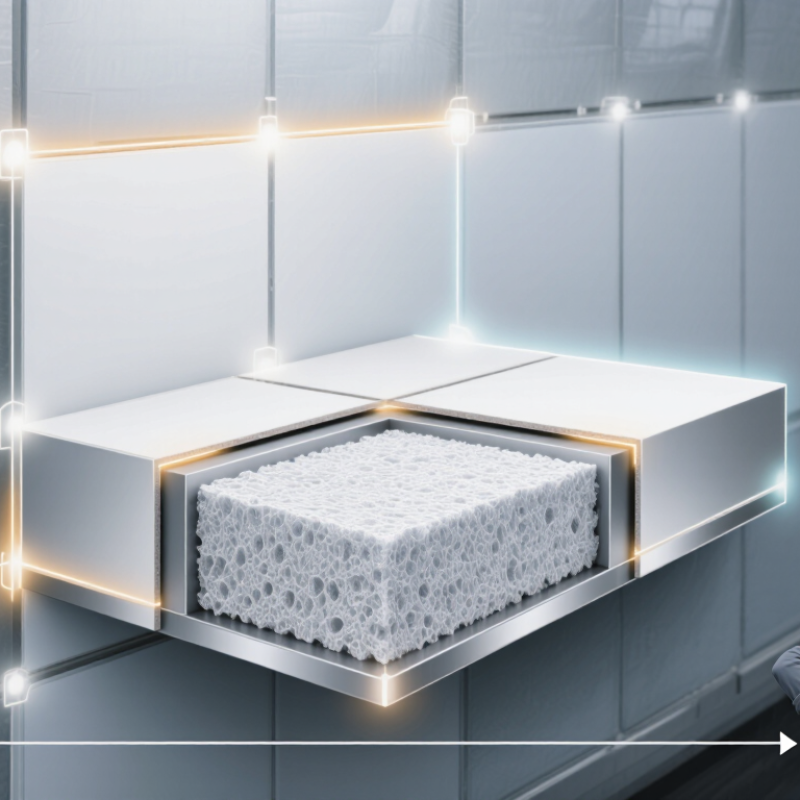
Thermal conductivity describes how readily heat moves through a material. For vacuum insulation panels (VIPs), it is commonly reported in watts per metre-kelvin (W/m·K). A lower value means less heat transfer under the stated test conditions. That matters. A VIP’s evacuated core limits gas movement, while its envelope helps maintain the vacuum. The core material, panel thickness, temperature, and test method can all affect the reported figure.
Compare values measured under similar conditions, and check whether a figure describes the panel’s centre or the whole assembly. The centre value may not include heat travelling around panel edges or through joints. Small gaps count. In a refrigerated cabinet, for example, a tight row of panels can still lose efficiency at seams or around fittings. A damaged envelope may also let the vacuum weaken, changing performance over time. A neat datasheet can tempt us to trust one number too much; the installation details deserve equal attention. Ask for test conditions and consider the temperatures the panel will actually face. Real projects are messier than lab samples. I would not assume the lowest published value automatically makes the best choice.
Defining the Required Insulation Performance
Defining the required insulation performance starts with the building assembly, not a VIP’s headline conductivity. Set the target U-value or R-value for the wall, roof, or appliance, then account for climate, available thickness, and installation details. Small details matter.
The IEA EBC Annex 39 report on high-performance thermal insulation places typical vacuum insulation panel center-of-panel conductivity around 0.004–0.008 W/(m·K). That is a core-panel value, not a guarantee for the finished assembly. Panel edges, joints, fixings, and gaps can create thermal bridges. Calculate their effect before selecting panel thickness. A neat laboratory number can look less impressive once seams are included.
Ask suppliers for tested values, measurement conditions, and aging data, then compare them with the project’s actual temperature range. For example, a cold-room wall and a sun-exposed roof face different heat-flow conditions. Check whether the reported figure describes the panel center or includes edge effects. If the answer is unclear, pause. I would not treat one conductivity value as enough evidence. Confirm the assembly calculation, installation tolerances, and expected service life with a qualified building-envelope professional.
How to Choose VIPs with the Right Thermal Conductivity - Defining the Required Insulation Performance
| Design scenario |
Available VIP thickness |
Target thermal resistance (R) |
Maximum effective thermal conductivity (λ) |
Selection guidance |
| Thin insulation layer where space is limited |
10 mm (0.010 m) |
1.5 m²·K/W |
≤ 0.0067 W/(m·K) |
Check that the specified value applies to the installed panel assembly, not only the center of the panel. |
| Compact appliance or insulated container |
15 mm (0.015 m) |
2.5 m²·K/W |
≤ 0.0060 W/(m·K) |
Allow for seams, panel joints, and any uninsulated areas when estimating overall heat flow. |
| General high-performance insulation layer |
20 mm (0.020 m) |
3.0 m²·K/W |
≤ 0.0067 W/(m·K) |
Compare conductivity values measured at similar mean temperatures and under comparable test conditions. |
| Building or equipment panel with a higher R-value target |
25 mm (0.025 m) |
4.0 m²·K/W |
≤ 0.0063 W/(m·K) |
Include edge and joint thermal bridges in the assembly calculation; they can reduce whole-panel performance. |
| Cold-storage or temperature-controlled enclosure |
30 mm (0.030 m) |
5.0 m²·K/W |
≤ 0.0060 W/(m·K) |
Assess performance over the intended service life, since VIP conductivity can increase with aging or damage. |
| Thicker VIP layer for a demanding insulation target |
40 mm (0.040 m) |
6.0 m²·K/W |
≤ 0.0067 W/(m·K) |
Confirm handling, installation, and protection requirements; puncturing a vacuum panel can substantially reduce its insulation performance. |
Calculation and specification note: The maximum conductivity values above are illustrative limits calculated from R = thickness ÷ thermal conductivity (λ = thickness ÷ R). They are not product ratings. Specify whether the required value is for the VIP center or for the installed assembly, and account for panel edges, joints, temperature, aging, and installation conditions. VIPs commonly provide very low conductivity—often in the low single-digit mW/(m·K) range—but actual values depend on construction, measurement method, and service conditions.
Matching Panel Materials to Operating Conditions
A VIP’s thermal conductivity is only useful when it reflects the temperature, humidity, and pressure it will face in service. Fumed-silica cores can offer stable insulation across varied conditions, while other core materials may suit applications where cost or panel thickness matters. Compare tested data at operating temperatures, not just a single headline figure. Ask how the value changes as the panel ages. Small differences matter.
The envelope matters too. In a chilled cabinet, repeated door openings can create condensation near panel edges; a durable barrier and careful joint design help limit moisture ingress and thermal bridges. In a hot installation, check the panel’s continuous temperature rating rather than relying on short-term exposure data. Measure the real load. A thinner panel may save space, yet tight corners, fasteners, and cut edges can reduce whole-wall performance. VIPs are also difficult to trim on site without damaging the vacuum. That constraint is easy to underestimate. Review panel dimensions, edge details, and installation tolerances with the actual assembly in mind, then request test results that match those conditions.
Comparing Conductivity Data and Long-Term Performance
Choosing a vacuum insulated panel (VIP) by its lowest published conductivity can be misleading. IEA EBC Annex 39 technical reviews report center-of-panel values commonly around 0.004–0.008 W/(m·K), depending on core and test conditions. That is a lab result, not the whole wall. Panel edges, joints, and installation details create thermal bridges; small panels can therefore perform less impressively across an assembly. Check whether a supplier reports center-of-panel or effective panel conductivity, and compare measurements taken under equivalent conditions. The distinction is easy to miss.
Long-term figures matter more. Gas and water-vapor ingress can raise conductivity as the vacuum weakens, while edge-seal design and exposure conditions influence the rate. EN 17140 provides a framework for declaring VIP product performance, but a declared value alone does not establish service life in a particular building. Ask for both initial and aged conductivity data, the aging method, specimen dimensions, and the assumed design life. Look for independent test reports, not only a single headline number. For a cold-store wall, I would also examine joints around corners and fasteners; a neat core value cannot reveal those losses. I would not treat one laboratory result as a lifetime promise. That uncertainty deserves attention.
How to Choose VIPs with the Right Thermal Conductivity
Typical thermal conductivity ranges show why both initial performance and aging matter when comparing vacuum insulation panels (VIPs) with conventional insulation.
Lower thermal conductivity means better insulation. VIPs can provide very low initial conductivity, but air and moisture entering through the envelope can raise it over time. Compare aged or design conductivity—not just the initial value—and check the test conditions and aging method for each product. Values shown are representative ranges; actual results vary by product and test method.
Balancing Thermal Efficiency, Thickness, and Cost
Vacuum insulation panels (VIPs) can deliver high thermal resistance in a slim build-up, but the core value is not the whole assembly. The IEA EBC Annex 65 report gives new VIP centre-of-panel conductivity at roughly 4–8 mW/(m·K); ASHRAE’s Handbook—Fundamentals places typical mineral-fiber insulation at about 34–45 mW/(m·K). That gap can free valuable space. It matters in a narrow retrofit reveal or a compact cold-room wall. That matters. Yet panel edges, joints, and fixings create thermal bridges, so a design based only on the best core figure may disappoint.
Thickness is only one part of the cost. Compare the installed cost per unit of whole-wall thermal performance, including protective facings, detailing, and replacement risk. A smaller panel may preserve usable floor area, but custom sizes and careful handling can raise project costs. Avoid cutting panels on site; a puncture can compromise the vacuum and sharply reduce performance. Not just the panel. I would also check the aged design value, not merely the initial laboratory result, and model edge losses before setting thickness. This is easy to overlook. Ask suppliers for test conditions and service-life assumptions, then compare those figures against the project’s space value and maintenance plan.
Conclusion
Choosing vacuum insulation panels (VIPs) with the right thermal conductivity starts with defining the insulation performance your application requires. Consider the surrounding temperature, available installation space, exposure to moisture or pressure, and the expected service life. These conditions help determine which panel materials and construction are suitable, since a low initial conductivity alone may not guarantee consistent performance over time.
When comparing options, review how conductivity is measured and whether the data reflects real operating conditions. Also consider aging, edge effects, and the impact of installation. The best choice balances thermal efficiency with panel thickness, durability, and total cost. By weighing these factors together, you can select VIPs that provide dependable insulation without adding unnecessary thickness or expense. Vip Thermal Conductivity is an important comparison point, but it should be assessed alongside long-term performance and the needs of the specific application.