
China Top Silica Core Vacuum Panel Supplier?

Time:2026-10-24 Author:Sophia
0%

Choosing a China Top Silica Core Vacuum Panel Supplier requires more than comparing online prices. It demands technical judgment, factory evidence, and careful attention to long-term performance. A silica core can deliver very low thermal conductivity, but only when its pore structure, density, moisture level, and envelope quality remain stable. Small defects may become serious after installation.

Professor J. Fricke, a widely cited vacuum-insulation researcher, has emphasized this practical principle: “A vacuum insulation panel is a complete system, not merely a core material.” That view remains important for buyers evaluating Chinese manufacturers. A reliable supplier should explain its production process clearly. It should provide thermal conductivity data, aging tests, dimensional tolerances, puncture resistance, and packaging details. Factory audits can reveal more than polished brochures. Look closely at core forming, vacuum sealing, laboratory equipment, and batch records.

Real projects also expose weak points. Panels may fit perfectly in a sample room, then fail during repeated handling or transport. A lower quotation can look attractive. It may hide thinner barriers, inconsistent vacuum levels, or limited after-sales support. No supplier is perfect. Even experienced manufacturers may need stronger documentation or better communication for overseas projects.

This guide examines China’s leading Silica Core Vacuum Panel suppliers through measurable criteria. It considers product consistency, customization ability, certification, production experience, export reliability, and technical service. The goal is not to promote the loudest company. It is to help buyers identify a supplier whose panels perform reliably behind walls, roofs, cold-chain systems, and industrial equipment.
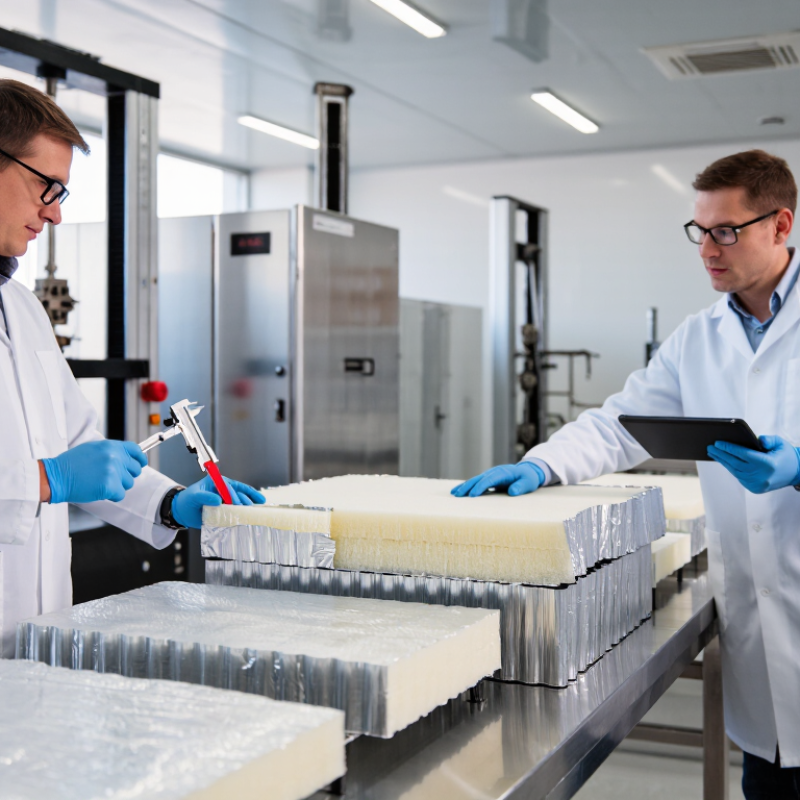
China Top Silica Core Vacuum Panel Supplier?

Silica Core Vacuum Panels: Structure, Materials, and ≤0.008 W/m·K Conductivity

China Top Silica Core Vacuum Panel Supplier?

Silica core vacuum panels combine a porous mineral core, barrier film, and sealed vacuum envelope. The core limits gas conduction, while the evacuated space reduces convection. Silica is often selected because its fine pores remain stable under compression and heat. However, panel performance depends on more than the core material.

A well-designed panel can achieve a declared thermal conductivity of ≤0.008 W/m·K under controlled laboratory conditions. EN 12667 provides a recognized method for measuring thermal resistance and conductivity. The International Energy Agency’s Buildings 2023 report states that buildings consume about 30% of global final energy. Thin insulation could therefore support valuable space savings in walls, roofs, and cold-storage equipment. Small details matter. Seams, folds, and penetrations can create thermal bridges.

Testing should include initial conductivity, aging, dimensional stability, and envelope integrity. ASTM C1676 addresses vacuum insulation panel evaluation, while ISO 8301 supports guarded hot plate measurements. Real installations may perform worse than laboratory samples. Moisture, handling damage, and gradual gas ingress can increase conductivity over time. That is the uncomfortable part. A supplier’s “≤0.008” figure may describe a fresh specimen, not a twenty-year assembly. Independent reports, batch records, and accelerated aging data deserve careful review before procurement.

China Supplier Evaluation: GB/T 39548, ISO 9001, and Factory Capacity

China Top Silica Core Vacuum Panel Supplier?

China Supplier Evaluation: GB/T 39548, ISO 9001, and Factory Capacity

Evaluating a silica core vacuum panel supplier requires more than comparing prices. Request the current GB/T 39548 test report, product drawings, and declared thermal conductivity values. Check whether the report matches the exact panel structure, thickness, and barrier film. A copied document proves little.

ISO 9001 shows that a quality system exists, but it does not guarantee every panel performs well. Ask to review incoming material records, vacuum pressure logs, sealing-temperature controls, and batch traceability. During a factory visit, inspect the core drying area carefully. Moisture control matters. Even small contamination can reduce vacuum stability over time.

Factory capacity needs practical verification. Count production lines, sealing stations, aging rooms, and finished-goods storage. Ask for monthly output during peak periods, not only the advertised maximum. I would also compare a production sample with the approved sample after transport simulation. This step is often skipped. That is a weakness. A supplier may have strong equipment but limited process discipline. Another may offer stable quality but lack enough capacity for a large project. Review rejection rates, spare equipment, inspection staffing, and delivery records before making a decision. Supplier claims should remain open to testing.

Performance Benchmarks: 25-Year Design Life and Fire-Rating Requirements

China Top Silica Core Vacuum Panel Supplier?

A 25-year design life is not a marketing phrase; it is a verification target. Vacuum insulation panels depend on core purity, envelope integrity, getter performance, and edge protection. Small punctures can sharply increase thermal conductivity. Field audits often find installation damage near corners, fasteners, and service penetrations.

The International Energy Agency reported that buildings consumed about 30% of global final energy in 2022. This increases pressure for durable insulation systems. For a 25-year project, suppliers should provide accelerated aging data, thermal conductivity retention, dimensional stability results, and documented production controls. Testing at initial delivery is insufficient. A panel can perform well in a laboratory, then weaken during transport or fitting.

Fire performance requires separate evidence. Silica cores are generally non-combustible, but facings, adhesives, edge seals, and coatings can change the final classification. EN 13501-1 evaluates reaction to fire through classes, smoke production, and flaming droplets. Project teams should request complete-system test reports, not only core material certificates. “A-rated” is not precise enough. Check the exact assembly, thickness, joints, and mounting method. The 25-year claim may still need deeper review. That is where many specifications remain imperfect.

Application Fit: Cold Chain, Buildings, and Industrial Insulation

China Top Silica Core Vacuum Panel Supplier?

Choosing a silica-core vacuum insulation panel supplier requires application evidence, not only a low quoted price. The IEA reports that buildings consume about 30% of global final energy and create roughly 26% of energy-related emissions. This makes thin, high-performance insulation valuable where wall space is limited. Properly tested vacuum panels can reach thermal conductivity near 0.004–0.008 W/m·K. Actual results depend on vacuum retention, sealing quality, and installation damage.

Cold-chain equipment needs stable temperatures during loading, transport, and storage. The FAO reports that about 13.2% of food is lost between harvest and retail globally. Better insulation cannot solve every logistics problem, but it can reduce compressor cycling and temperature recovery time. Silica-core panels suit refrigerated cabinets, cold rooms, and insulated doors. Their edges need careful protection. One small puncture can weaken performance.

Buildings require different evidence. Look for fire behavior, dimensional stability, aging data, and thermal bridging control. Industrial systems may need panels around pipes, tanks, or process equipment, where vibration and maintenance access matter. Testing should follow recognized methods, such as ISO 8302, with declared values at specified temperatures. A supplier should provide sample testing and batch records. I still question any promise based only on initial conductivity. Real service conditions are less perfect.

China Top Silica Core Vacuum Panel Supplier? - Application Fit: Cold Chain, Buildings, and Industrial Insulation

Application-fit guide for silica-core vacuum insulation panels (VIPs), focusing on thermal efficiency, space constraints, operating conditions, and installation requirements.

Application Typical Temperature Range Main Performance Target Why Silica-Core VIPs Fit Key Design Considerations Typical Use Cases Application Fit
Cold Chain Approximately −40°C to +10°C, depending on the equipment and logistics environment. Very low thermal conductivity
Typical VIP values are approximately 0.002–0.008 W/m·K at 25°C when new and properly evacuated.
Provides substantially higher thermal resistance per unit thickness than conventional polyurethane or expanded polystyrene insulation. Edge conduction, panel joints, puncture protection, moisture control, and long-term vacuum retention should be evaluated. Cold-temperature testing and condensation control are important. Refrigerated containers, vaccine and pharmaceutical shippers, insulated boxes, portable cold storage, and high-performance refrigerated equipment. High Fit
Building Envelope Commonly −20°C to +60°C in building assemblies; actual limits depend on the facing, seal design, and local climate. Maximum insulation within limited thickness
Useful where floor area, façade depth, or interior space is restricted.
Can deliver high thermal resistance in slim wall, roof, floor, balcony, and retrofit assemblies where conventional insulation thickness is impractical. Panels must be protected from drilling, cutting, compression damage, fire exposure, and prolonged moisture. Thermal bridges at joints and fasteners require detailed design. Passive-house components, prefabricated wall panels, cold-room envelopes, balcony slabs, narrow refurbishment zones, and space-constrained roofs. High Fit
Industrial Insulation Often suitable for moderate-temperature zones; higher-temperature service requires application-specific materials and validation. Reduced insulation thickness and heat loss
Especially valuable around compact equipment, access-limited areas, and complex assemblies.
Silica has low solid-phase thermal conductivity, while the vacuum structure reduces gas conduction, enabling compact insulation designs. Confirm continuous-use temperature, thermal cycling, mechanical loading, chemical exposure, fire performance, and compatibility with the panel barrier film before specification. Process equipment, compact tanks, cryogenic auxiliary sections, thermal appliances, test chambers, and insulated housings. Medium to High Fit
Cryogenic and Low-Temperature Systems Below 0°C, potentially down to cryogenic conditions when the complete panel construction is specifically qualified. Low heat ingress and stable insulation performance
Design must account for temperature-dependent conductivity and contraction.
High thermal resistance per unit thickness can help reduce external dimensions and conserve usable internal volume. Qualification should cover vacuum retention, thermal cycling, permeation, sealing, dimensional stability, and compatibility with cryogenic service conditions. Specialized transport containers, laboratory equipment, low-temperature storage, and cryogenic support assemblies. Application Specific
High-Temperature Industrial Zones Above approximately +100°C, depending strongly on the barrier film, adhesive, seal, and facing construction. Controlled heat transfer under validated conditions
Long-term durability is usually more important than minimum initial conductivity.
The silica core itself can tolerate higher temperatures than many polymeric insulation materials, but the complete VIP is limited by its weakest component. Do not select solely from core-material data. Verify continuous-use temperature, peak temperature, thermal cycling, outgassing, fire behavior, and enclosure compatibility. Selected industrial panels, thermal barriers, laboratory systems, and equipment with moderate high-temperature requirements. Limited / Validate

Technical note: Thermal conductivity values vary with temperature, internal pressure, panel thickness, aging, moisture, edge effects, and test method. Final selection should be based on the complete panel assembly, certified test data, expected service life, and installation conditions rather than core material data alone.

Comparing Top Suppliers: Cost, Testing, Lead Time, and MOQ

China’s silica core vacuum panel suppliers should be compared beyond unit price. IEA EBC Annex 39 reports vacuum insulation panels with initial thermal conductivity commonly near 0.002–0.008 W/m·K. However, edge leakage, punctures, and aging can reduce performance. Ask suppliers for tested values, not brochure estimates.

Testing should follow recognized methods, including ISO 16478 or relevant EN requirements. Request thermal conductivity, vacuum retention, compression strength, dimensional tolerance, and accelerated aging results. A complete report should show sample size, test temperature, and laboratory details. Missing evidence is a warning sign.

Cost varies with thickness, protective film, shape, and annual volume. Small trial orders often carry higher tooling and packaging charges. Standard panels may ship within two to four weeks, while custom sizes can require six to ten weeks. MOQ also differs widely, so compare total landed cost rather than factory price alone. My practical mistake was accepting a low quotation before checking carton damage and rejected-panel rates.

Tips: Request three identical samples. Measure thickness after transport. Confirm whether MOQ covers each size or the whole order. Record lead time from drawing approval, not the first inquiry. A cheap panel that arrives late is not cheap.

China Top Silica Core Vacuum Panel Supplier? Comparing Cost, Testing, Lead Time, and MOQ

The chart compares representative anonymous supplier profiles using typical silica-core vacuum insulation panel procurement benchmarks. Costs are shown in USD/m², while testing time, production lead time, and minimum order quantity are shown in days and m². Actual figures should be confirmed through technical documents and formal quotations.

FAQS

What is a silica-core vacuum insulation panel?

It combines a porous mineral core, a barrier film, and a sealed vacuum envelope. The vacuum reduces convection. The fine pores limit gas movement.

How low can its thermal conductivity be?

Some panels declare conductivity between 0.004 and 0.008 W/m·K. This value usually comes from controlled laboratory testing. Real performance may differ.

Why can thin panels save building space?

They provide strong insulation with less thickness than many conventional materials. This can preserve interior space in walls, roofs, and doors. Small seams still matter.

Can these panels support cold-chain applications?

They can suit refrigerated cabinets, cold rooms, insulated doors, and transport equipment. Good insulation may reduce compressor cycling and temperature recovery time. It cannot fix every logistics problem.

What can reduce panel performance after installation?

Punctures, moisture, damaged folds, and gradual gas entry can increase conductivity. Corners and fastener locations deserve careful inspection. One small puncture matters.

Does a 25-year design life guarantee twenty-five years of performance?

No. It is a verification target, not automatic proof. Request aging data, dimensional stability results, and envelope-integrity evidence. Fresh samples are not enough.

Are silica-core panels automatically fire-safe?

Not necessarily. The mineral core may resist burning, but facings, adhesives, seals, and coatings affect classification. Review complete-system fire reports. Check joints and mounting methods.

What information should buyers request from a supplier?

Request declared conductivity, test temperatures, batch records, sample reports, and accelerated aging results. Also inspect edge protection and installation guidance. A low price may hide uncertainty.

Conclusion

A Silica Core Vacuum Panel is a high-performance insulation solution built from a porous silica core enclosed in a low-permeability protective barrier. By removing internal air, the panel can achieve thermal conductivity of ≤0.008 W/m·K, helping reduce heat transfer while saving valuable installation space. This article explains how the structure and materials affect insulation efficiency, durability, and handling requirements.

When evaluating suppliers in China, buyers should review GB/T 39548 compliance, ISO 9001 certification, testing procedures, production capacity, and quality-control systems. Key performance considerations include a potential 25-year design life, suitable fire-rating documentation, and reliable performance in cold-chain logistics, buildings, and industrial insulation. A practical supplier comparison should also examine total cost, independent test results, lead time, minimum order quantity, customization capability, and after-sales support. Selecting the right supplier requires balancing technical performance, project conditions, delivery reliability, and long-term value rather than focusing only on the lowest initial price.

Sophia

Sophia

Sophia is a dedicated marketing professional with an exceptional depth of knowledge about her company's products and services. With a keen understanding of market trends and customer needs, she crafts insightful blog posts that not only inform but also engage readers, enriching the company’s online......